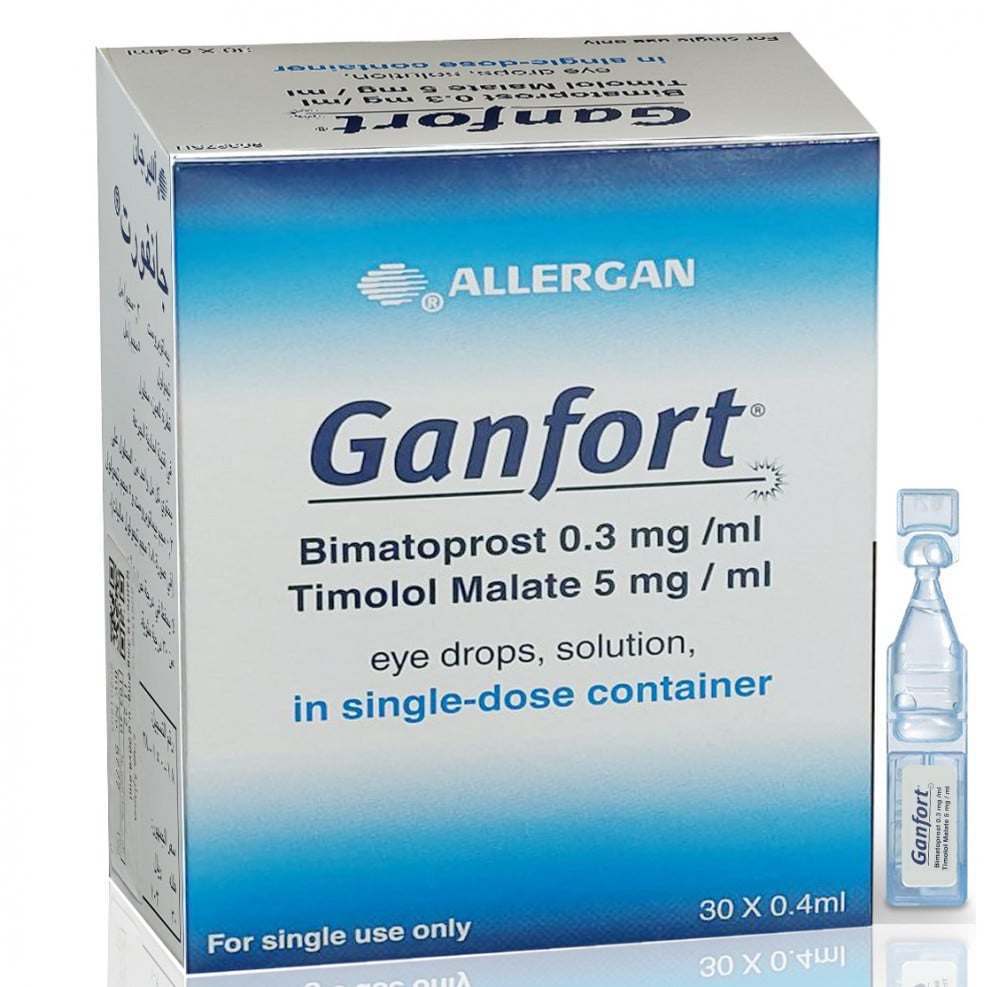
GANFORT EYE DROPS 3ML is a combination medicine of Timolol - a beta-blocker agent used in ophthalmology.
Mechanism of Action
GANFORT consists of two active ingredients: bimatoprost and timolol maleate. These two components lower intraocular pressure (IOP) through a complementary and synergistic mechanism of action, resulting in more reductions in intraocular pressure than the individual components. Ganfort quickly gets up and running.
Bimatoprost is an effective intraocular pressure lowering agent. It is a synthetic prostamide, which is molecularly related to prostaglandin F2α (PGF2α) and acts through the specific prostamide receptor.
Bimatoprost lowers intraocular pressure in humans by increasing the drainage of aqueous humor through trabecular networks and uvea (via Schlemm's canals).
Timolol is a beta-1 and beta-2-adrenergic receptor blocker (non-selective), with no intrinsic sympathomimetic or direct inhibition of myocardial activity, and no anabolic effects. Local sensitization (membrane stabilizing action). Timolol lowers intraocular pressure by reducing the formation of aqueous humor.
Clinical Effects
Bimatoprost lowers intraocular pressure with an IOP-lowering effect that reaches a peak in about 12 hours; Timolol has an effect on lowering intraocular pressure that reaches its peak in about 1-2 hours. Both bimatoprost and timolol significantly reduce intraocular pressure after the first dose.
Ganfort's intraocular hypotensive effect was not less than that of adjunctive treatment with bimatoprost (once / day) and timolol (twice / day).
Some of the available literature on Ganfort suggests that evening administration may be more effective in lowering IOP than taking it in the morning. However, the possibility of adherence should be considered when considering morning or evening doses.
Use in children
The efficacy and safety of Ganfort in children 0-18 years of age has not been established.
pharmacokinetic properties
drug ganfort
Plasma concentrations of bimatoprost and timolol were determined in a crossover study comparing monotherapy with Ganfort in healthy subjects. Systemic absorption of each drug is minimal and is not affected by the combination in one formulation.
In two 12-month studies evaluating systemic absorption, no drug cumulation of the individual components was observed.
Bimatoprost
Bimatoprost penetrates well into the cornea and sclera of humans in the laboratory. After ocular administration, the systemic exposure to bimatoprost was very low and did not accumulate over time. After instillation of 1 drop of bimatoprost 0.03% once daily into both eyes for 2 weeks, peak blood concentrations were reached within 10 minutes of instillation and decreased to below the detectable limit (0.025 ng/mL) within 1.5 hours of instillation. The mean values of peak concentration (Cmax) and area under the concentration curve (AUC0-24h) were similar between day 7 and day 14 at about 0.08 ng/mL and 0, respectively. .09 ng • h/ml, respectively. This indicates that steady-state drug concentrations are achieved during the first week of dosing.
Bimatoprost is moderately distributed in body tissues, with a constant human volume of distribution of 0.67 L/kg. In human blood, bimatoprost is mainly in plasma. Bimatoprost is approximately 88% bound to plasma proteins.